
Industry Focus: Solar Installation
- Gyru-Star Team
- Mar 12
- 6 min read
The global transition towards renewable energy has accelerated the construction of solar farms across Europe, North America and beyond. As governments and energy providers invest in green infrastructure, vast solar arrays are being installed at an unprecedented rate.
However, solar panels are only part of the equation. Every solar farm requires an extensive network of underground high-voltage cables, both within the site itself and connecting the installation to the wider electricity grid. This means many kilometres of trench must be excavated, laid and protected.

The Challenges of Cable Protection
Protecting high-voltage cables requires suitable padding material to protect them from damage. Traditionally, this has meant importing sand or other certified backfill material.
With the cost of sand increasing and availability limited in some regions, the expense of protecting underground services can escalate quickly. On large solar installations, material and haulage costs soon become a significant part of the overall project budget.
Logistics add another challenge. Solar farms are often located on agricultural land or remote sites where access is restricted. Narrow tracks, soft ground conditions and environmental limitations can make it difficult to transport large screening plant or additional machinery.
For contractors working in these conditions, a more practical approach is needed.
Recycling Trench Arisings
To control material costs, many contractors are now recycling the material already available on site. Trench arisings can be processed and reused as cable padding material, reducing both material purchases and waste disposal costs while simplifying site logistics.
Before this material can be reused, it must first be screened. In most utility applications, this means removing particles larger than 8 to 10 mm to produce a suitable protective layer around the cable.
Why Screening Buckets?
While several screening options are available, screening buckets offer a practical combination of mobility and efficiency for this type of work. These attachments turn any excavator, loader or skid steer into a powerful mobile screener and address several of the key challenges contractors face on modern jobsites.
A Cost-Effective Solution
Screening buckets require a much smaller capital investment than traditional mobile or static screeners, and running costs are also significantly lower. Beyond the initial purchase price, contractors benefit from reduced fuel consumption, minimal maintenance requirements and the ability to utilise existing machinery already on the job.
Screening buckets can also help to cut haulage expenses. With no need to transport spoil to an external screening plant or bring replacement material back to site, contractors can reduce vehicle movements, fuel use and time lost to logistics. For large utility or solar installations, these savings compound quickly, making screening buckets one of the most financially efficient solutions available.
Access Any Jobsite
Solar farms and utility corridors are frequently located in remote areas or on agricultural land where access is limited. Screening buckets can operate in confined or difficult terrain that is inaccessible to screening plant or larger machinery.
Utilise Existing Machinery
Because screening buckets are compatible with excavators, loaders and skid steers already working on the project, contractors avoid bringing additional equipment onto site. This keeps the jobsite lean, reduces fuel consumption and streamlines operations. This is especially useful for small teams.
Screen Directly into the Trench
Unlike static or off-site screening options, screening buckets allow operators to process material exactly where it’s needed. Fines can be placed directly into the trench over the cables, speeding up backfilling and ensuring the material is applied evenly for consistent protection.
Poly-Star vs Steel Rotor Screening Buckets
There are two types of screening bucket that are commonly used for producing padding material. These are steel rotor buckets and polyurethane star screening buckets. Whilst both operate on a similar principle, they produce two very different products.
Traditional steel rotor screening buckets tend to crush and shred material during processing. While this may reduce particle size, it also mixes rocks, roots and debris into the soil, compromising the quality of the finished product.
For cable padding, this presents a problem. Protective backfill must be clean and consistent. Crushing oversize material does not remove the contamination; it simply breaks it into smaller pieces. In some cases, the sharp edges created by crushed rock may also increase the risk of cable damage.
Polyurethane star screening buckets operate differently. The flexible stars rotate to create a rolling motion that gently separates fines from oversize material. Rocks, roots and debris are removed intact, leaving a clean and consistent padding material suitable for protecting underground services.

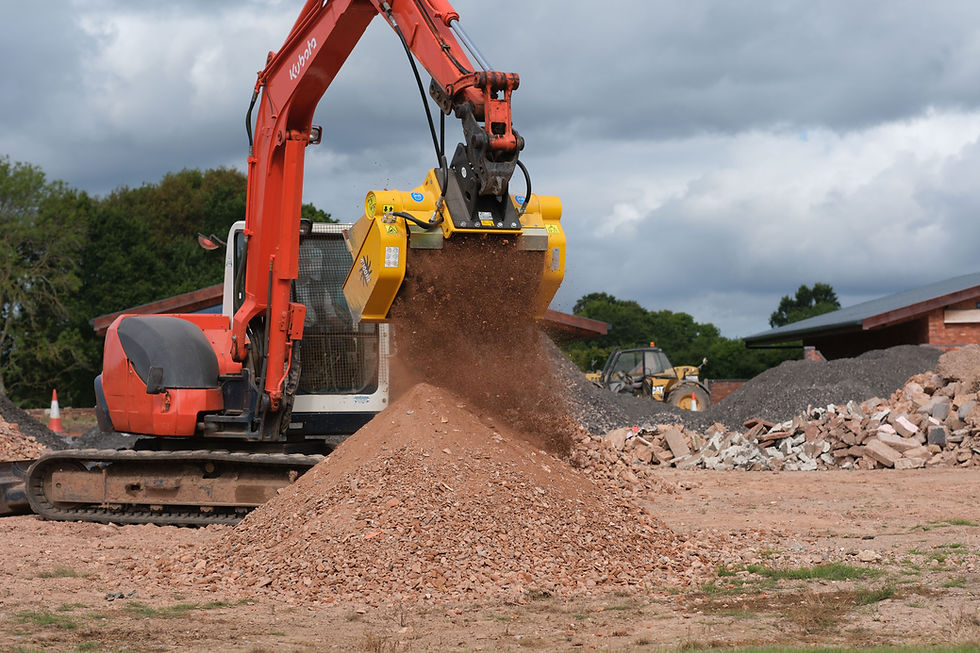
As you can see in the image above, this non-destructive process produces two clearly separated outputs: a fine material suitable for cable protection and oversize.
A Proven Approach in Sweden
Whilst poly-star screening buckets are now widely used on solar and utility projects around the world, Swedish contractors were among the earliest adopters of the technology.
One example is Lars Olsson of Östervärn Gräv AB. Lars and his Huddig 1260D backhoe were contracted by E.ON to install high-voltage underground cables as part of a major upgrade to the regional electrical grid.

Swedish regulations require all cable padding material to be under 8 mm, and with suitable sand becoming both scarce and increasingly expensive, Lars quickly recognised that his screening bucket could offer a more efficient solution.
Having used Gyru-Star screening buckets on previous projects, he understood how the attachment could reduce material costs and simplify installation.
“At the start of the project, I had to get approval from E.ON to use the screening bucket,” he explained. “However, it was not difficult to get E.ON to understand the benefits, and it didn’t take long to get approval.”
By recycling trench arisings directly on site, Lars was able to produce a consistent sub-8 mm padding material without transporting spoil to an external screening plant or importing new backfill.
The ability to screen directly into the trench also improved productivity and ensured the protective layer was evenly distributed across the cables.
This approach reduced material and machinery movements, lowered operational costs and significantly reduced the environmental impact of the project. It also allowed Lars to work more independently on site, which was particularly valuable when operating with a small team in remote locations.
Built for Utility Contractors
Following feedback from utility contractors, Gyru-Star developed a range of dedicated padding buckets known as the MAX Series. These models feature an extended cutting edge, which makes it easier to work with the smaller stockpiles common on these projects.
Ultra-Low Maintenance
Whilst most screening buckets are chain-driven, Gyru-Star buckets use self-tensioning carbon belt drives. These require no lubrication or adjustment, and sealed bearings are also used throughout. This means almost zero maintenance.
Reduced Risk of Contamination
The carbon belt driveline and sealed bearings also reduce the risk of hydrocarbon contamination. To further reduce this risk, all hydraulic components are housed in a sealed cavity within the shell to protect against accidental damage.
Wide Carrier Compatibility
Gyru-Star offers the largest range of screening buckets on the market, with 31 models across 6 series. Each model is optimised for a specific carrier weight range.
This provides a dedicated screening solution for excavators from 1 to 30 tonnes, loaders from 1 to 15 tonnes and skid steers from 1 to 9 tonnes.
Gyru-Star screening buckets are also compatible with all makes and models of tiltrotator, as the hydraulic system is designed to handle high back pressures and low flow rates. The system also does not require a case drain and can run on just a hammer circuit.
Looking Ahead
As solar installations continue to expand worldwide, the demand for underground cabling will only increase. Managing costs, reducing waste and improving efficiency will remain key priorities for contractors and utility providers.
Recycling trench arisings into cable padding material provides a practical solution. Polyurethane star screening buckets combine mobility, non-destructive screening and low operating costs. This allows contractors to reduce reliance on imported materials while producing a consistent and reliable protective backfill.
Join the growing number of contractors improving productivity with Gyru-Star screening buckets. Reach out to our team or your local dealer to discuss the best model for your machine and project requirements.

Comments